The Verb That Turns a Headline into a Claim
Learn how headline verbs signal certainty, separate reported actions from interpretation, and read claims more carefully before drawing a conclusion.
When a headline says a minister “admits” a mistake, did the minister concede it, or did the writer interpret a statement that way? Reading headline verbs carefully helps you separate what someone did or said from what the headline claims it means. The distinction can change how a whole story feels.
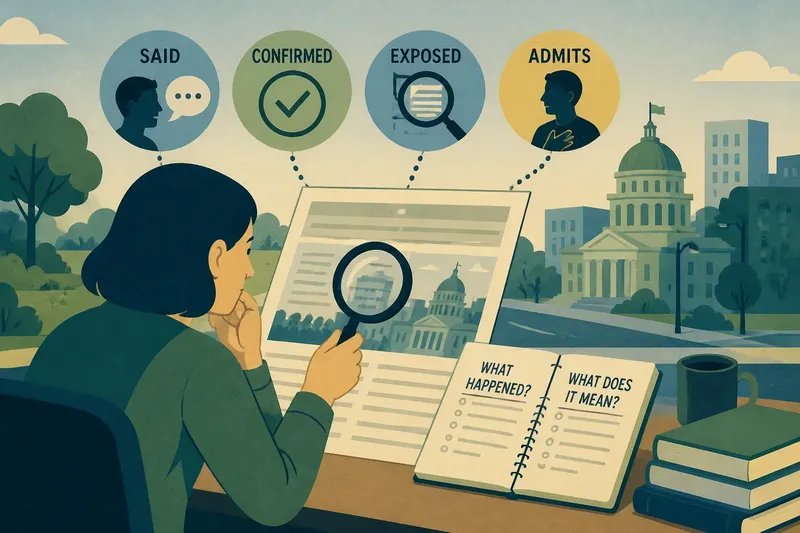
Verbs carry more than action. “Said” attributes words to a person; “confirmed” suggests those words settle a question; “exposed” implies concealed wrongdoing. A headline may use a compact verb to compress a complicated account, but compression can turn a reported event into an interpretation. You can slow that shift down without dismissing the story or assuming bad faith.
Start with the verb and identify its work
Read the headline once for its basic subject and action, then look again at the main verb. Ask what it claims happened. Does it describe an observable act, report what somebody said, infer a motive, or judge the significance of an event?
These categories often overlap, but separating them gives you a useful first reading:
- Observable action: “The council postponed the vote.” The verb names an action that can be checked against the meeting record.
- Attributed speech: “The council leader said the vote would be postponed.” The headline reports a statement, not necessarily the event itself.
- Interpretation: “The council leader retreats on the vote.” “Retreats” casts the change as a reversal or concession.
- Evaluation: “The council leader caves on the vote.” “Caves” adds judgement about pressure and resolve.
Do not treat the categories as a scale from false to true. An interpretive verb may fit the evidence, and an apparently plain verb may leave out important context. The point is to see which kind of work the headline is doing before accepting its framing.
Separate what happened from what it means
Rewrite the headline in your mind using the least interpretive verb that still preserves the stated event. “The company caves after complaints” might become “The company changes its policy after complaints.” This does not establish whether “caves” is unfair. It reveals the underlying claim you can check: a policy changed, and complaints preceded the change.
Then divide the headline into two questions. What event or statement is being reported? What interpretation has been attached to it? The first may be supported by a document, a recording or a named source. The second may depend on motive, pressure, consequence or comparison with earlier conduct.
For example, “The mayor admits the plan failed” contains at least two claims. The mayor may have said that the plan did not meet its aims; “admits” suggests reluctance or prior concealment, while “failed” gives an assessment of the plan. The article may supply evidence for both, but the headline alone does not show it.
Check who owns the verb
Find the sentence or passage in the story that supports the headline. Notice whether the verb belongs to the reporter or to a quoted source. “Residents say the factory stinks” attributes the description to residents. “The factory stinks” presents it as the publication’s own assertion. “Inspectors found a strong odour” reports a more specific observation, though the details still matter.
Attribution can be clear in the headline and less visible in a short social post or search result. Open the story and look for phrases such as “according to the report”, “the group argues”, or “officials described”. These mark the boundary between an event and somebody’s account of it. If that boundary is missing, check whether the body text makes it clear.
Pay attention to reporting verbs, too. “Said” is broad. “Claimed” can imply doubt, although it may simply introduce an assertion that remains disputed. “Insisted” suggests persistence in the face of challenge. “Acknowledged” often frames the statement as a concession. None of these words settles whether the source is accurate; each tells you how the writer is presenting the act of speaking.
Test verbs that imply motive or consequence
Some verbs describe a visible action while smuggling in a theory about why it happened. “Blocked” may mean a proposal was prevented from advancing, but it can also imply deliberate obstruction. “Targeted” suggests that a person or group was singled out. “Triggered” assigns a cause. “Threatened” may describe a direct warning, or it may characterise a statement whose meaning is contested.
When a verb implies motive, ask what evidence could support that reading. A direct statement of intent is different from an inference based on timing or effect. When a verb implies causation, ask whether the story identifies other possible causes. When it implies consequence, look for the measure or event that demonstrates the result.
Say you see the headline “New parking rules punish local traders”. The observable claim might be that the rules changed and traders face new restrictions. “Punish” says more: it frames the effect as an imposed penalty, perhaps deliberately directed at traders. In the story, look for the rule itself, the stated reason for it and the traders’ account of its effects. If the report supports the restrictions but not an intent to penalise, you can retain the factual concern without inheriting the stronger accusation.
Read the sentence around the evidence
Once you have identified the verb’s implication, inspect the evidence offered nearby. A document may establish that a decision was made, while an interview supplies a person’s explanation of why. A video may show an exchange but not what happened before or after it. The format of the evidence affects which verbs it can support.
Look for distinctions among:
- what a record directly states;
- what a named person says the record means;
- what the reporter infers from several pieces of information;
- what remains disputed or unknown.
Ask whether the headline preserves these distinctions. If a document lists a decision but does not discuss motive, “the document reveals why” may reach beyond what it contains. If a source characterises a decision as “a retreat”, the story should make clear that this is the source’s interpretation unless it independently supports the description.
Also read the next sentence rather than stopping at the first supporting detail. It may qualify the claim, report a response or explain that an effect has not yet occurred. A headline can be defensible in broad terms while still sounding more settled than the account beneath it.
Compare the headline with the story’s degree of certainty
Headlines have limited space, but brevity does not make certainty irrelevant. Compare the verb’s confidence with the language in the article. If the story says an explanation is “possible” or that officials “are investigating whether” an event occurred, a headline that states the cause as fact deserves a closer look.
Distinguish a firm action from an uncertain account of that action. “The agency opened an inquiry” may be straightforward if the inquiry is documented. “The agency probes fraud” can imply that fraud is established, even if the inquiry is only examining an allegation. A more careful account might say that the agency is investigating allegations of fraud.
There is no need to replace every strong verb with a weak one. Strong language is appropriate when the evidence supports it. Your task is to notice where confidence enters the sentence and whether the reporting earns it.
Ask what headline verbs leave unclear?
Is “claims” different from “says”?
“Says” reports that a person made a statement; “claims” often signals that its truth is unverified or contested. Neither word proves the statement true or false, so look for attribution and any evidence the story provides.
Does “admits” mean someone confessed?
Not necessarily. It usually frames a statement as a concession, so check whether the person acknowledged the point directly and whether the surrounding account supports the sense of reluctance or disclosure.
Can “reveals” describe an ordinary announcement?
It can, but the word suggests that information was previously hidden or unknown. Check what was known before, who made the information available and whether the story identifies anything that was concealed.
What should I do when the headline and story use different verbs?
Use the story’s wording and evidence to identify the most defensible description, then treat the headline’s stronger phrasing as an interpretation. If the article never explains the gap, keep the claim provisional rather than filling it with an assumption.
Keep a plain-language version of the claim
Before sharing or discussing the story, put its central event into neutral language. Name the actor, the action and the source of the information. “The department announced a review” is more precise than “The department caves” if the account establishes an announcement but leaves the motive open.
This is not a demand for bloodless writing. It is a way to keep your own reading distinct from the publication’s framing. A drawer label tells you what is inside; it does not tell you whether the contents are admirable or shameful. Headline verbs often do both jobs at once, and noticing the second job gives you room to decide whether the judgement is earned.
When you return to the headline, read its main verb alongside the evidence, not as a substitute for it. That small pause is useful whenever a headline appears to settle motive, blame or consequence before the story has made its case. It leaves you with a clearer account of what is known and a more honest view of what remains interpretation.