A Correction Is Not Always a Reversal
A correction is not always a reversal: learn to tell changed facts from clarified details and wording, so you can update your understanding without discarding the whole story.
A correction is not always a reversal. If a local report changes a meeting’s location after publication, the first version was wrong about where it happened, but that does not automatically undo its account of what happened there. The useful question is narrower: which claim changed, and what does that change mean for the rest of the story?
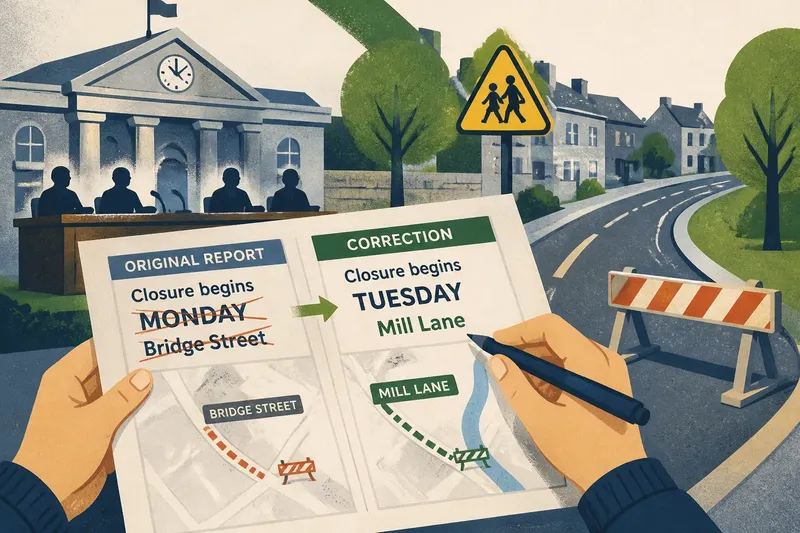
Imagine a clearly hypothetical report about a town council approving a temporary road closure near a primary school. The first article says the closure will begin on Monday and affect Bridge Street. Later, an editor adds a correction: the closure begins on Tuesday, and the affected road is Mill Lane. Readers now have to distinguish two changed details from the separate claim that councillors approved the closure.
A correction identifies a change, not its full reach
The word “correction” tells you that something in the published account has been amended. It does not, by itself, say whether the error was small, central or consequential. A useful notice names the inaccurate statement, gives the corrected information and, where possible, explains how the error occurred or what else it affects.
In the imagined report, the starting point is a specific claim: Monday, Bridge Street. The revised version supplies Tuesday, Mill Lane. Those facts matter to anyone planning a journey, and the change may alter the practical value of the article. But it does not necessarily affect the report’s separate account of the council vote, the reason for the closure or the stated duration.
Think of an article as a paper map with several labels. Replacing one street name changes how a reader locates the route; it does not redraw every road on the page. The comparison has limits, but it helps keep a localised amendment from becoming either invisible or larger than the evidence warrants.
Read the correction against the original claim
Do not rely only on a headline, a social post or the correction notice in isolation. Find the updated article and compare the amended wording with the earlier claim if it is available. Some publishers mark changes in the text; others add a dated note at the end. The details may be presented differently, so look for the actual sentence that changed.
In this case, ask whether the revision changes only the start day and street, or whether it also changes what councillors decided. If the article now says the council merely discussed a closure, rather than approved one, the central account has shifted. That would be a more substantial change than correcting a location, even if the notice uses the same word.
A simple reading sequence can help:
- Find the correction notice and note the exact claim it identifies.
- Locate that claim in the current article, rather than relying on a clipped excerpt.
- Check whether nearby sentences were revised to match the new information.
- Look for any stated effect on the article’s main conclusion.
- Keep the changed detail separate from claims the notice does not address.
This is not a scoring system. It is a way to stop one amended sentence from silently rewriting your memory of the entire report.
Separate a changed fact from a clarified detail
A changed fact replaces an earlier assertion with a different one. “The closure begins on Monday” becoming “The closure begins on Tuesday” is a direct change. So is replacing Bridge Street with Mill Lane. The earlier detail cannot remain true in the same sense once the publisher has corrected it.
A clarification can instead make an imprecise statement more exact without reversing its basic meaning. Suppose the first article says that “the school entrance will be affected”. The editor later specifies that the delivery gate, not the pupil entrance, is beside the closed road. That revision changes the reader’s understanding of the practical impact, but it may clarify what the original phrase was intended to cover rather than overturn the council’s decision.
Wording changes need closer attention. An editor might replace “the council closed the road” with “the council approved a temporary closure”. The new phrase may be more precise about who has authority to act and whether the closure has started. It may also correct a substantive error if the first wording gave readers a false impression that barriers were already in place. The changed words matter because they alter the claim a reader is asked to accept.
When the distinction is unclear, avoid guessing at the newsroom’s intention. Read the revised sentence and the correction note together. If the note does not explain whether the underlying fact changed or the wording was sharpened, treat that uncertainty as unresolved rather than filling it with a confident interpretation.
What should readers ask when a story changes?
Does a correction mean the whole story is false?
No. It means at least one part needed amendment; the notice and revised article show the stated scope. If the changed claim supports the story’s central conclusion, though, the correction may have wider consequences.
How can I tell whether the main point has changed?
Identify the article’s central claim in plain language, then check whether the correction alters the evidence or event on which that claim depends. A revised date may leave the central account intact, while a changed vote result or decision may not.
What if the correction notice is vague?
Compare the current article with any earlier version the publisher makes available, and note what remains unexplained. If the unresolved point affects a decision you need to make, seek a clearer account from the publisher or an authoritative source before relying on it.
Should I share the corrected version?
If you share the story, link to the current version and mention the correction when the changed detail matters to your point. Avoid circulating an old screenshot or excerpt as if it still reflected the article’s current wording.
Trace what the change means for the story
Return to the hypothetical council report. Say you had planned to use Bridge Street on Monday because of the article. The corrected day and location alter that practical choice: you would now check the council’s current road notice before deciding where to travel. Yet if your interest is whether the council approved a temporary closure, the same correction does not answer that question differently unless the revised account also changes the vote or its outcome.
This illustrates why “minor” and “major” are not universal labels. A changed street name can be central to a resident’s route and peripheral to a discussion of council procedure. The significance depends partly on what the reader needs to know. The factual status of the change, however, should still be clear: the original location was incorrect, and the article now gives another one.
Check whether the revised detail is consistent through the article. A correction notice might give Tuesday while an earlier sentence still says Monday. That leaves the report internally inconsistent, even if the notice is accurate. Likewise, a revised opening paragraph may change the story’s framing while a caption or summary retains the old wording. Look beyond the sentence highlighted in the notice when connected details could affect the same point.
Where the right answer depends on an official notice, a publisher’s stated correction policy or local rules, consult the relevant source rather than inferring details from an article alone. In the imagined road-closure case, the council’s current notice would be the appropriate place to verify the date and affected road; it would not, by itself, settle whether the journalism accurately described the meeting.
Keep the correction attached to your understanding
Once you have worked out what changed, update the particular belief that depended on the old wording. Do not keep repeating the original detail from memory, but do not discard unrelated claims merely because the article carries a correction. If the amendment leaves an important question open, mark that question as open.
For the hypothetical report, a careful reader might retain three separate points: the published location and start day were corrected; the article still reports that councillors approved a temporary closure; and the current travel arrangements should be checked against the council’s notice. Each statement has a different basis and a different level of certainty. Keeping them separate is more useful than calling the whole article either reliable or unreliable.
A correction is evidence about the article’s changing record. Read it closely enough to see what was wrong, what replaced it and what remains untouched. That gives the correction its proper weight—and lets the next version of the story become clearer without pretending the earlier error never mattered.