One Open Question for a Sunday News Review
A Sunday news review built around one open question helps you compare relevant coverage, spot what remains uncertain and carry a useful note into the week.
What is the one part of a story you still cannot explain? A Sunday news review built around one open question gives that uncertainty a proper place: instead of scrolling through another pile of headlines, you gather the coverage that bears on it and record what remains unanswered.
The aim is not to settle every disputed issue before the week begins. It is to read with a defined purpose, notice how different accounts fit together and leave yourself a clear note about what would change your understanding. The ritual can be brief, but it should be deliberate enough to distinguish an unresolved question from a vague feeling that you have missed something.
Choose a question that can guide your reading
Keep a small list during the week. When a story leaves you puzzled, write down the question rather than saving every article that mentions it. “What happened?” is usually too broad. “Which part of the council’s plan is funded, and which part is still proposed?” gives you something specific to look for.
A useful question concerns an identifiable uncertainty in the coverage. It might ask who made a decision, what evidence supports a claim, what changed between two updates or which groups are affected. It should be open enough that you do not already know the answer, but narrow enough that several relevant reports can help you examine it.
On Sunday, scan your list and select one question. Prefer the one that matters to your understanding of a continuing story, not simply the one attached to the most dramatic headline. If the question depends on information that has not been released, you can still review the coverage; the unresolved status is itself something to record.
Try to write the question in neutral language. “Why is the agency hiding the figures?” assumes that concealment is happening. “What figures has the agency released, and what remains unavailable?” leaves room for the coverage to show whether information is missing, delayed or simply outside the scope of a report.
Set a boundary before opening more coverage
Once you have chosen the question, decide what material is relevant. That boundary prevents the review from becoming a tour of every related argument. If you are asking what is known about a transport disruption, for instance, include reports on the disruption, statements from the operator and any account that clarifies the cause or current status. A general opinion piece about public transport may not help answer that particular question.
Gather a small working set from outlets with distinct reporting or access where possible. Look for a direct account, such as a published statement or document, alongside reporting that explains its significance. A local report may include details absent from a national summary; a later update may clarify what an earlier account could not. Diversity here means different relevant vantage points, not simply more links.
Before reading closely, note each item’s date and what kind of material it is: a developing report, an interview, a news release, an analysis or an official document. These labels are not verdicts on reliability. They help you see what each item can contribute and what it cannot. A statement may establish what an organisation says it has decided, while leaving the reasons or consequences contested.
Set aside material that does not bear on the question, even if it is compelling. This is not a judgement that the material is unimportant. It is a way to protect the purpose of the review. A kitchen sieve separates what you are looking for from the rest without pretending the rest does not exist; your reading boundary can work in much the same way.
Read across accounts for what each adds
Read each item with the question beside you. Afterward, write one short note: what does this account add? Record a concrete point, such as a date, a stated decision, an identified source or an explicit limitation. Avoid copying a whole passage, because a note in your own words makes you decide what the information actually contributes.
Then compare the notes. Do accounts agree on the basic event but differ over its cause? Does one name a document while another paraphrases a statement? Does a newer report add information, or does it repeat an earlier claim with a fresher headline? These comparisons are more useful than counting how many articles express the same conclusion.
Separate what is reported from what is inferred. “The department has not published the figures” is different from “the department is withholding the figures to avoid scrutiny.” The first may be checkable against the material you have; the second proposes a motive that requires additional support. If coverage makes that leap, note it as an interpretation rather than folding it into the established account.
Also notice the shape of the available information. A report may quote two people with opposing views but offer little detail about the process they are discussing. Another may include a document yet leave its context unexplained. Your question helps identify which omission matters, instead of treating every absent detail as equally important.
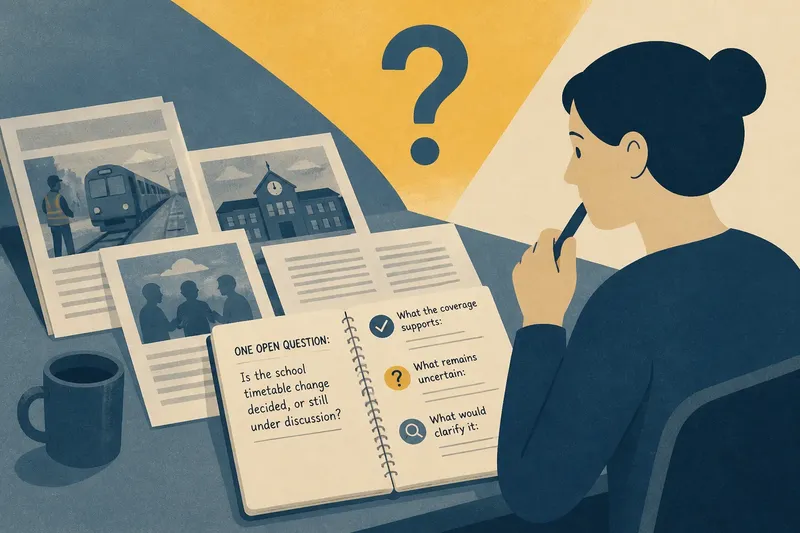
Say you are trying to understand whether a school’s announced timetable change has been decided or is still under discussion. Imagine that, over the week, you have saved a school notice, a local report and an account from a parents’ group. In the Sunday review, you find that the notice describes a proposal, the report says consultation is continuing, and the group raises a concern about travel arrangements. Your note could say that no final timetable is evident in these items, while the practical effect on families remains unclear. That is a useful reading result, even without a definitive answer.
Write down what remains unanswered
End the comparison with three distinct notes: what the coverage supports, what remains uncertain and what information would help resolve the uncertainty. Keep the first note modest. It should reflect the material you actually read, not every fact you think may be true.
- What the coverage supports: a point that appears clearly in the material you reviewed.
- What remains uncertain: a specific gap, disagreement or claim whose basis is not clear.
- What would clarify it: a document, explanation, response or later development that bears directly on the gap.
Do not turn the last note into a prediction. “A published timetable would clarify whether the proposal is settled” names useful information. “The school will publish the timetable next week” is a forecast unless a source has said so. Keeping the distinction visible makes it easier to return later without mistaking expectation for an update.
Mark how confident you are in the notes with plain language rather than a score. You might write “clear in the notice,” “reported by one outlet” or “not established in the material I read.” This keeps the basis for your judgement close to the judgement itself. If you later see stronger or contradictory coverage, you can revise the note without defending an old impression.
Keep the review small enough to repeat
Give the ritual a fixed place in your Sunday, such as after breakfast or before you plan the coming week. Keep one page in a notebook or one document for the question, the items reviewed and the three closing notes. A consistent location means you can return to the thread without rebuilding it from a browser’s history.
Keep the reading set modest. If you have already found several accounts that bear directly on the question, another dozen links may add volume rather than clarity. Add an item when it offers a different source, a material update or relevant context. Leave out one that merely repeats the same claim without showing where it comes from.
It is fine to stop with “not enough information yet.” That answer is more informative than a forced conclusion. It tells you that the available coverage does not settle the point, and it makes the limit of your review visible. The discipline is not to keep searching until uncertainty disappears; it is to notice when further reading is no longer adding anything.
If your chosen question has grown too large, narrow it for the next review rather than abandoning the practice. “What is happening with the housing proposal?” might become “Has the council published its revised proposal?” The narrower wording gives the next reading session a clearer boundary and makes a meaningful update easier to recognise.
Decide whether the question should carry forward
At the end of the review, choose one of three outcomes. Close the question if the coverage has answered it sufficiently for your purposes. Carry it forward if the gap still matters and new information may become available. Reword it if the original question smuggled in an assumption or covered too much ground.
When you carry it forward, preserve the closing notes and add new material only when it changes the picture. A new report may answer the question, complicate it or leave it untouched. Each outcome is useful. If nothing relevant has changed, write that plainly and let the story wait rather than reopening the same search out of habit.
Close it when the remaining uncertainty no longer matters to the decision or understanding that prompted the question. Closure does not require certainty about every aspect of a story. It means you have learned what you needed for now, and can name what remains outside the scope of your review.
Questions that make a Sunday review easier?
How many articles should I read?
There is no fixed number that suits every question. Stop when you have enough relevant material to compare what is supported, what differs and what is still missing; add another account only when it could contribute something distinct.
What if the coverage does not answer my question?
Record the unanswered point and the information that would help clarify it. An unresolved question is a legitimate result, not a reason to infer an answer from silence or repeat the same search without a new lead.
Should I choose a different question every Sunday?
Choose a new one when a different story matters more or the previous question has been resolved. Carry an unresolved question forward when it still helps you read a developing story with care, but do not keep it merely because it is already in your notes.
What if two accounts contradict each other?
Write down exactly what conflicts and check whether the accounts refer to the same time, decision or evidence. If the difference remains, preserve it as an open point rather than blending the claims into a single account.
For your next Sunday news review, keep the question itself at the top of the page. That small choice makes it easier to tell a useful update from a fresh headline that only revives the story, and it leaves you with a record of what you know, what you do not and what would genuinely help next.