Interview, Document or Dataset: Pick the Source for the Question
Choose an interview, document or dataset by the question you need answered, and see what each source can establish—and what it leaves uncertain.

Which source can answer the question you have: an interview, a document or a dataset? The right choice depends on what you need to know. An interview can explain a person’s experience or reasoning; a document can show what was recorded or formally stated; a dataset can reveal patterns across collected observations. None answers every kind of question.
Read each source as evidence for a particular claim, not as a general stamp of truth. A source may be useful and still leave important parts of the story unresolved. Start by putting your question into plain words, then match its shape to the material.
Choose an interview for experience, explanation and disputed recollection
If you want to know what someone saw, intended, decided or experienced, an interview is often the most relevant source. A resident can describe how a service changed in their neighbourhood. An official can explain the reasoning they say informed a decision. A worker can describe what a procedure looks like in practice.
Interviews give readers access to memory and interpretation, not an automatic record of events. People may remember selectively, misunderstand what happened or speak from a particular interest. The fact that a statement is detailed does not, by itself, confirm it.
Ask who is speaking, what they could directly know and whether the account distinguishes observation from inference. “I saw the meeting end early” is different from “the meeting ended early because the decision had already been made”. The first describes an observation; the second adds an explanation that may need separate support.
Interviews are also useful when the question concerns language or motive. A written policy may say what an organisation intends to do, while a conversation can clarify how a decision-maker understands it. Treat that explanation as the speaker’s account, then check whether other evidence supports the relevant claims.
Choose a document for recorded terms, decisions and instructions
If you need to know what an organisation put in writing, look for the document closest to the claim. A signed agreement can establish the terms it records. A meeting minute can establish what its author recorded as discussed or decided. A public notice can show the wording issued to its intended audience.
Documents have boundaries too. A policy does not establish that staff followed it. Minutes may summarise a meeting rather than capture every exchange. A draft is not the same as an approved version, and an excerpt may omit conditions elsewhere in the text.
Check the document’s title, date, issuing body and status. Look for definitions, footnotes, appendices and later amendments. If a report says a form changed, the form itself may show what the change was; it may not explain why it happened or how consistently people used it.
Documents are especially helpful for questions about exact wording: What did the notice promise? What does the rule require? Which conditions apply? For questions about whether an instruction was followed, pair the document with evidence of what people actually did.
Choose a dataset for distributions, comparisons and change
If you want to know how often something occurred, how cases differ or whether a pattern appears across many observations, a dataset may be the best fit. It can help answer questions such as which categories appear most often in a set of records, or how recorded cases are distributed across areas.
A dataset is not a complete view of reality. It contains what was collected, according to particular definitions and methods. Missing records, changed categories or a narrow collection process can shape the pattern a reader sees. A count of reported incidents, for instance, concerns recorded reports; it does not automatically show every incident that occurred.
Before accepting a comparison, inspect what each field means, which cases are included and whether the periods or groups were recorded in comparable ways. Look for a data dictionary, methodology note or description of exclusions. A tidy table can conceal messy choices, much as a labelled cupboard can make its contents look more uniform than they are.
Datasets are strongest for questions about groups and patterns, not for explaining a particular person’s experience or proving why a change happened. A pattern can prompt a useful question. To explain it, readers may need interviews, documents or other evidence that addresses causes.
Match the source to the question you are asking
Say you want to know why a local clinic changed its appointment system. The published notice could establish what patients were told and when. A dataset of appointment records might show which appointment types changed in the records. Interviews with staff and patients could explain how the change was understood or experienced. Together, these materials would address different parts of the question; none should be treated as a substitute for the others.
Use this quick distinction when deciding where to look first:
- “What did this person experience or intend?” Start with an interview, then distinguish direct observation from interpretation.
- “What was formally stated, agreed or required?” Find the relevant document and check its status and surrounding terms.
- “How common was this, or how did groups compare?” Look for a dataset and inspect how cases were defined and collected.
- “Was a written rule followed?” Read the document for the rule, then seek evidence about actual practice.
- “Why did the pattern change?” Treat the dataset as a description of the pattern and seek sources that can address possible explanations.
Which source should you look for first?
Can an interview prove what happened?
An interview can provide a person’s account, including what they recall seeing or doing. For a disputed event, check whether documents or other accounts support the specific claims.
Does a document show what happened in practice?
Usually, it shows what was recorded, issued or agreed in that document. To establish what people did, look for evidence of implementation, such as records or relevant accounts.
Can a dataset explain why a pattern exists?
It can describe recorded patterns and comparisons, but the figures alone may not identify their causes. Look for evidence suited to the proposed explanation and consider how the data was collected.
What if the source I need is unavailable?
Say what the available material can support and what remains unanswered. Do not treat a source of the wrong type as a replacement simply because it is easy to find.
Let the evidence set the limit of the claim
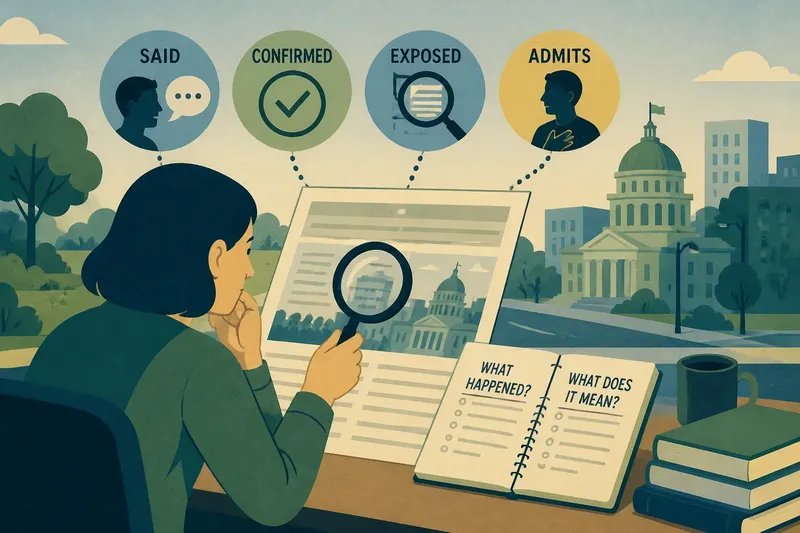
When you read a report or article, notice whether its source fits the claim being made. A quotation may support what someone said; a document may support what was recorded; a dataset may support a pattern within its collection. If the conclusion reaches beyond that, look for the missing link rather than assuming the source supplies it.
For a source question, the clearest reading begins with a narrower question: experience, recorded terms, or a pattern across cases. Choose the source that can speak to that subject, then keep its limits visible. That small distinction makes it easier to tell what is established, what is interpreted and what still needs evidence.